The best starting point for Ray-Ban Meta lenses is the part of your day when you most want to wear the glasses. A pair used at a desk and on evening calls has a different job from a pair used mainly outdoors. Choosing a lens color first can hide that difference.
Clear, photochromic, tinted and polarized describe different ways of handling light. Single vision and progressive describe prescription design. Decide those questions separately, then confirm that the combination can be supplied for your exact frame.
Compare what the four options actually change
For a first shortlist, use the situation you want to improve rather than the most impressive-sounding label.
On a narrow screen, swipe sideways to see all four columns.
| Lens option | The main decision | A useful reason to investigate it | A question to settle first |
|---|---|---|---|
| Clear | No added tint | You mainly want everyday indoor use. | What will you use for bright outdoor conditions? |
| Photochromic | Tint changes with exposure to light | You regularly move between indoors and outdoors. | How does the exact lens behave indoors, outside and behind glass? |
| Tinted | A fixed color rather than an automatic change | You want a consistent sunglass or fashion tint. | What are the color and light-transmission specifications? |
| Polarized | A filter targets reflected glare | Glare from reflective outdoor surfaces is a priority. | Can you comfortably read the screens you use? |
Polarization is a specific optical function, rather than a synonym for a dark color. ZEISS explains the filtering principle using reflections from surfaces such as water and roads. Its product specifications belong to ZEISS lenses; they do not establish the performance of another supplier’s lenses.
If you wear the glasses inside as much as outside
Start by deciding how much added tint you want indoors. If calls, music and ordinary indoor wear are the main reason for owning the glasses, clear lenses deserve consideration before a sun-lens upgrade. You can then decide separately how you will handle outdoor use.
Photochromic lenses are worth considering when you repeatedly cross between indoor and outdoor environments and want a lens that changes its tint. But “changes tint” leaves several practical questions unanswered: how clear it looks after returning inside, how dark it gets in your usual conditions, and how long the change takes.
Ask for the product name and the supplier’s specifications rather than relying on a friend’s different pair. A branded Transitions lens and an unnamed photochromic lens are not interchangeable descriptions. The behavior of a particular Transitions generation cannot establish what Fovevia’s photochromic option will do.
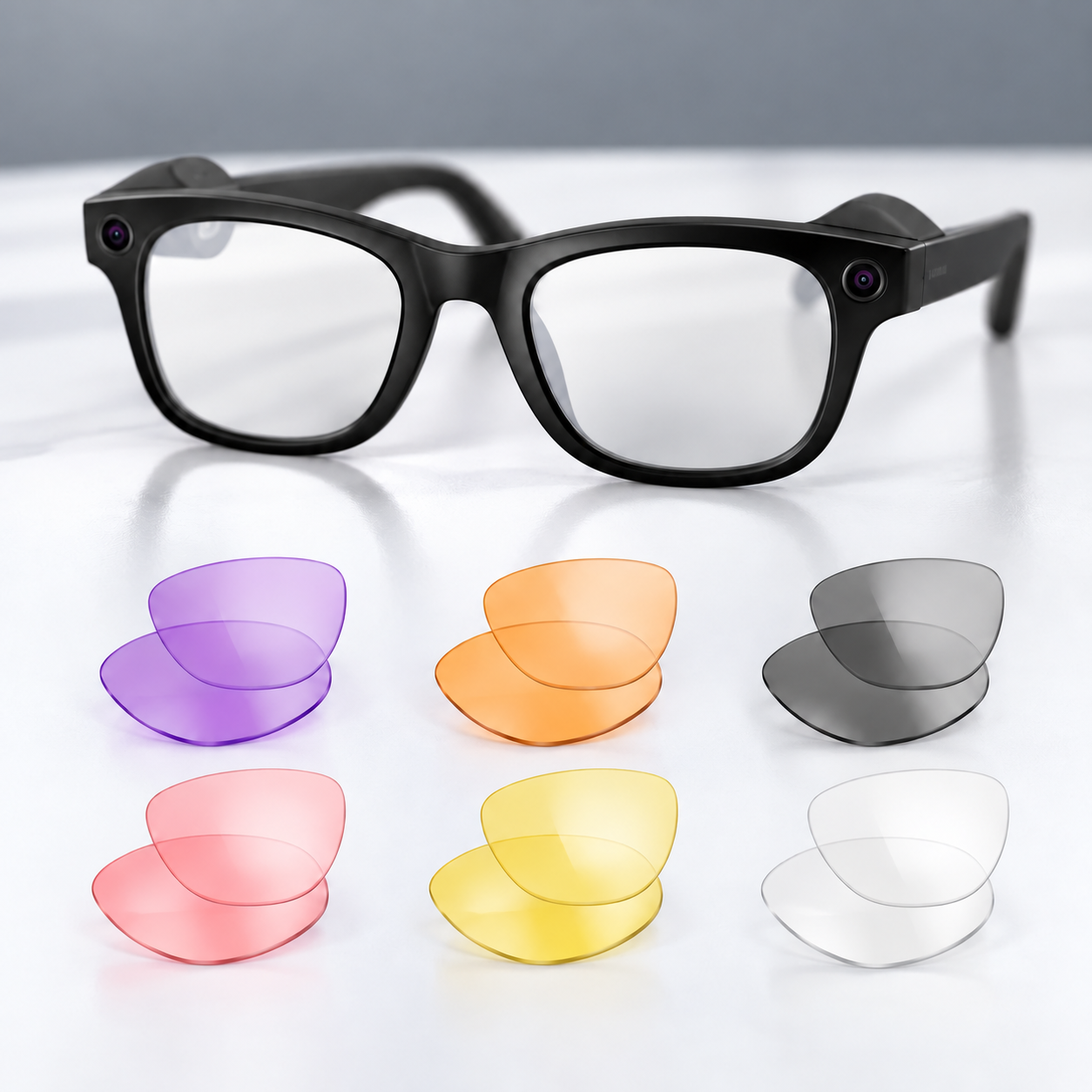
For outdoor glare and driving, ask more than “how dark?”
If reflections from water or roads are what bother you, polarization is a relevant feature to investigate. A fixed tint and a polarizing filter answer different questions: one establishes a consistent shade, while the other changes which reflected light passes through. A photograph of gray lenses does not tell you whether they are polarized.
Include your phone and other important displays in the decision. ZEISS identifies digital-screen viewing as a situation where polarization needs consideration. Ask to check the actual lens-and-screen combination at the angles you normally use, rather than assuming that every polarized lens will affect every screen identically.
Driving adds another variable: the lens is behind a windshield. Transitions’ own explanation describes limited in-car activation for GEN S and distinguishes it from other products in its range. That is a reason to check the named lens, not a basis for saying all photochromic lenses either work fully in cars or never change at all.
If driving is your main use, ask the supplier about the exact lens’s suitability for the light conditions involved. Request its transmission and driving-use information. Neither a dark product photo nor the word “photochromic” settles that question.
Prescription design is a separate choice
You can need single-vision correction regardless of whether you prefer clear or colored lenses. A progressive design addresses multiple viewing distances; it does not, by itself, mean that a lens changes tint or contains a polarizing filter.
On Fovevia’s Ray-Ban Meta lens page, the current form separates Lens Type from Lens Vision. The first lists Clear, Photochromic, Tinted and Polarised. The second lists Single Vision, Progressives and Non-prescription, with an ADD field associated with the progressive choice.
Do not interpret separate menus as a promise that every possible combination is available. Confirm your chosen design and lens type together, including any fitting information the supplier needs. Use the Prescription Guide for the document details rather than changing prescription values to match a preferred option.
Choose from your routine, then ask for the missing details
Think through one ordinary day. Where will you first put the glasses on, where will you spend the longest uninterrupted period wearing them, and when would the lens choice make you take them off? That last question often reveals more than the color you prefer in a photograph.
- Mostly indoors: begin with clear, and decide how you will handle outdoor sun separately.
- Frequent indoor-to-outdoor movement: investigate photochromic, asking about the exact product’s indoor appearance and change in your likely conditions.
- Mainly outdoor wear with a consistent look: compare fixed tints by the actual color and transmission specifications.
- Reflective glare is the main problem: investigate polarized lenses, including a check of the displays you rely on.
Before ordering, confirm the complete frame name, generation and size; Fovevia’s listing specifically asks for those details. Also ask for the lens material, UV-protection specification, coating information, installation arrangement and confirmation of your chosen prescription combination. These details should come from the supplier for the product you are ordering.
Fovevia’s public page does not identify its photochromic option as Transitions or publish a measured darkening time or transmission range. If those details decide the purchase for you, contact Support before selecting the option. Other established device and prescription articles are available in Guides.