Built-in focus dials may be enough for your VITURE or Rokid glasses if they give you a clear, comfortable image for the things you actually watch or read. A prescription insert becomes worth investigating when the available adjustment does not cover your needs, or when correction that the dial cannot provide still matters. Having astigmatism does not automatically mean everyone needs to buy an insert.
Start with the complete model name. VITURE Pro and Luma Pro have different adjustment limits, even though both names include “Pro.” The number on a product page describes the device’s adjustment, not a complete assessment of your vision.
The dial range changes with the model
These are the manufacturer-published myopia adjustment ranges for the models below, checked on October 15, 2026. They describe adjustment for the virtual image; they are not prescription ranges for an insert.
| Glasses model | Published built-in myopia adjustment | What to check next |
|---|---|---|
| VITURE One / VITURE Pro | 0.0D to −5.0D | Use the original One/Pro instructions, not a newer Pro model’s specifications. |
| VITURE Luma | 0.0D to −6.0D | Keep the plain Luma name distinct from Pro and Ultra. |
| VITURE Luma Pro / Luma Ultra | 0.0D to −4.0D | Check the exact model and frame size before choosing a prescription frame. |
| Rokid Max | 0.00D to −6.00D | Follow the Max adjustment instructions for each eye. |
| Rokid Max 2 | 0.00D to −6.00D | Use the Max 2 manual for adjustment and prescription-accessory guidance. |
The figures come from VITURE’s One/Pro documentation and Luma-series documentation, plus Rokid’s separate explanations for Max and Max 2. Do not carry these figures over to another generation.
Why a sharp-looking picture may still leave a question
A dial offers a way to adjust the virtual image for nearsightedness. It does not reproduce every part of an eyeglass prescription. In particular, VITURE’s Luma documentation identifies astigmatism as something its built-in adjustment does not support. Rokid likewise identifies astigmatism, farsightedness and needs beyond the Max 2 dial range as reasons to consider additional prescription lenses.
That distinction can matter more while reading small text than while watching a scene that has few fine details. Someone deciding whether subtitles look acceptable is making a different practical comparison from someone reading a spreadsheet for work. Neither comparison establishes which prescription they need.
The National Eye Institute explains that mild astigmatism may cause no noticeable symptoms and may not require treatment; an eye-care professional determines whether correction is needed. There is no useful universal rule that a particular CYL value makes inserts compulsory for every wearer.
Try your real viewing task before buying another part
Use the manufacturer’s fitting instructions first. Choose the appropriate nose pads and wearing position, then adjust the focus controls as the manual describes. Rokid’s instructions describe adjusting one eye at a time. A device that moves on your nose can change what you see even when the prescription has not changed.
Pick one ordinary task you expect to repeat: a page of subtitles, a game menu, or the document you plan to read. Keep the content and text size the same while checking fit and adjustment. Record whether the image improves, whether one side remains less clear, and whether moving the frame changes the problem.
If the result is clear and comfortable for that task, the mere existence of an insert does not create a reason to order one. If you reach the end of a dial without a usable result, or clarity remains unsatisfactory, stop chasing extra turns and ask for help. These observations help explain the problem; they cannot distinguish an outdated prescription from every possible fit or device issue.
When an insert deserves a closer look
An insert is a reasonable next question when your correction needs fall beyond the model’s published adjustment, when farsightedness needs consideration, or when astigmatism correction remains relevant after normal fitting. Bring your current eyeglass prescription and the exact device name to the conversation. Do not order stronger lenses to “future-proof” a prescription.
Keep device adjustment and lens manufacture separate. Do not subtract a dial number from your prescription or combine custom lenses with an improvised extra setting. Ask the insert supplier how its lenses should be used with that model’s controls. An insert also cannot guarantee that every cropped corner or position-sensitive blur will disappear.
If the display’s physical closeness is making you consider a reading prescription, our explanation of virtual-image distance and prescription choice describes why those distances can differ. If you only have a contact lens document, check why it should not automatically replace an eyeglass prescription before ordering.
Match the insert after deciding what it needs to do
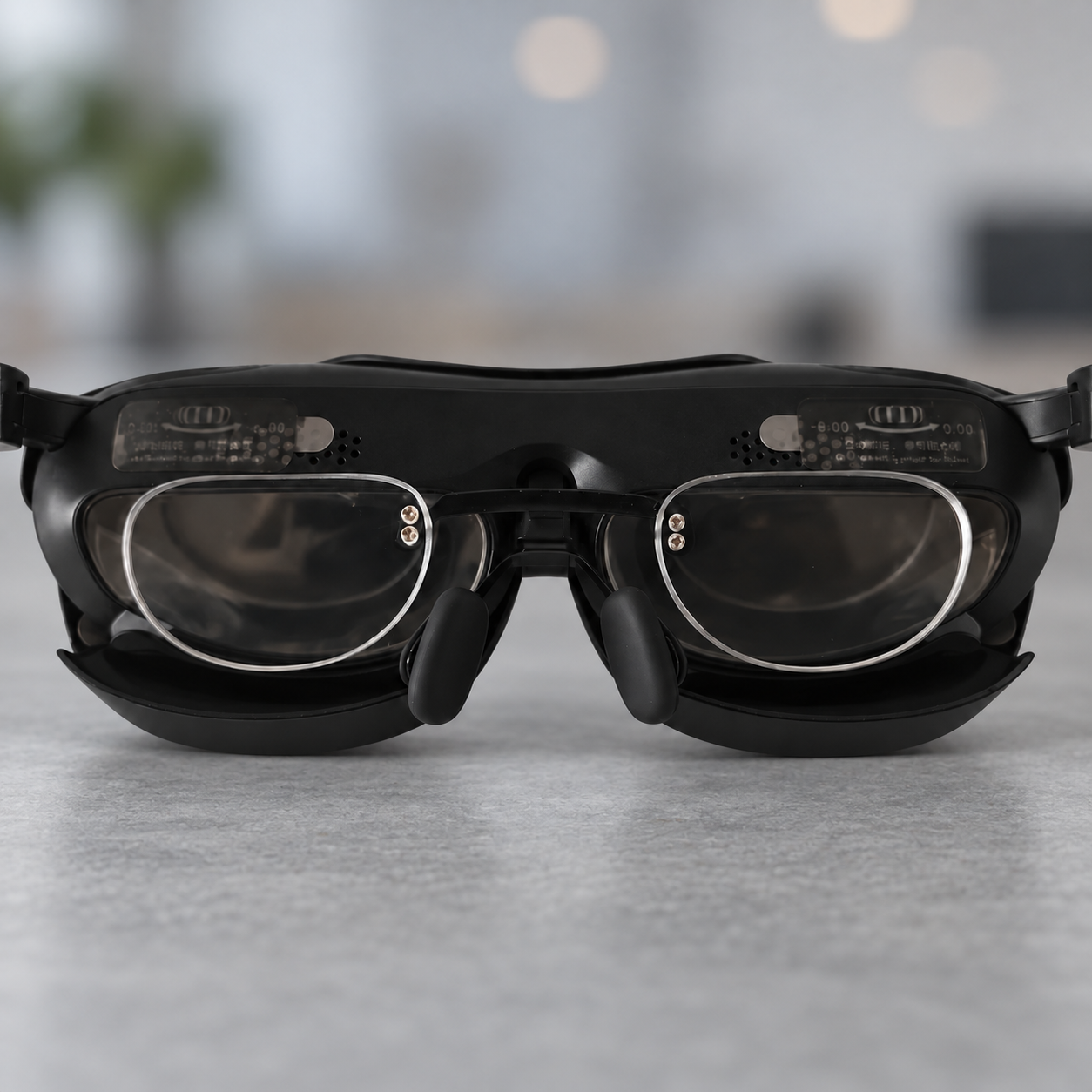
The next purchase check is physical fit. Fovevia has separate listings for VITURE One and Pro, VITURE Luma, Luma Pro and Luma Ultra, and Rokid Max and Max 2. A shared brand name is not enough to choose between them.
- Confirm the full model name and any frame-size variant.
- Identify whether you need a frame only, lenses only, or an assembled lens-and-frame set.
- Have the original right- and left-eye prescription details available, including CYL and AXIS where specified.
- Ask about prescription availability, required fitting information and the starting dial position before paying.
Fovevia’s Luma listing asks customers to confirm prescription availability with support before ordering. Use the Prescription Guide for the document details, or send the device and fitting questions through Support. More device-specific reading is collected in Guides.