A strong prescription does not tell you, by itself, whether a particular VR insert can be supplied. Before ordering complex VR prescription lenses, get confirmation for both eyes, the exact headset and the finished insert—not just a number in a dropdown. High sphere or cylinder values, prism, and information the form does not represent deserve an answer before payment.
The awkward case is a prescription that one shop rejects while another website lets you enter it. That difference is a reason to ask what the second provider has actually approved. It is not a reason to alter the prescription until an order goes through.
When the form lets you continue, ask what that means
Lens providers set their own product limits. Some publish separate sphere, cylinder and total-power requirements; others route certain orders through additional review. For example, Zenni’s Quest help page lists all three kinds of limit. Reloptix describes a special-order process that can involve extra lens sourcing and a different frame. Neither company’s process establishes what another supplier can make.
A useful question is: “Have you confirmed this complete prescription for this device, or have I only completed the entry form?” Ask for the answer in writing, especially when a field is missing or a combination needs individual review.
| What you notice | What to confirm before ordering |
|---|---|
| A strong plus or minus sphere | Whether both complete eye prescriptions are accepted for the selected insert. |
| A high cylinder value | Whether the cylinder and its axis are accepted together with that eye’s sphere. |
| Prism and a base direction | Whether the product can represent and supply that correction. |
| ADD, separate distance/near sections or unfamiliar notation | Which information the product requires, with the full record available for clarification. |
| A value outside the menu | The review route; do not choose the closest available value. |
Keep the prescription intact while the questions are resolved
There is more to check than the largest number on the page. The Association of Optometrists explains that cylinder describes astigmatism correction, axis gives its orientation, and prism has a strength and direction. Those details belong with the correct eye. A missing axis beside a nonzero cylinder is a clarification question, not an invitation to guess.
Preserve the signs and notation on the original document. If a website uses a different cylinder convention, ask the provider how to proceed. Do not transpose it yourself, reduce a value to avoid a surcharge, or leave prism out because there is nowhere obvious to enter it.
The prescriber resolves uncertainty about what was prescribed; the insert supplier resolves product acceptance and ordering. If your only record is for contacts, our article on glasses versus contact lens prescriptions explains the document issue. If the uncertainty is distance versus reading correction, use the distance-prescription explanation before selecting a section of the record.
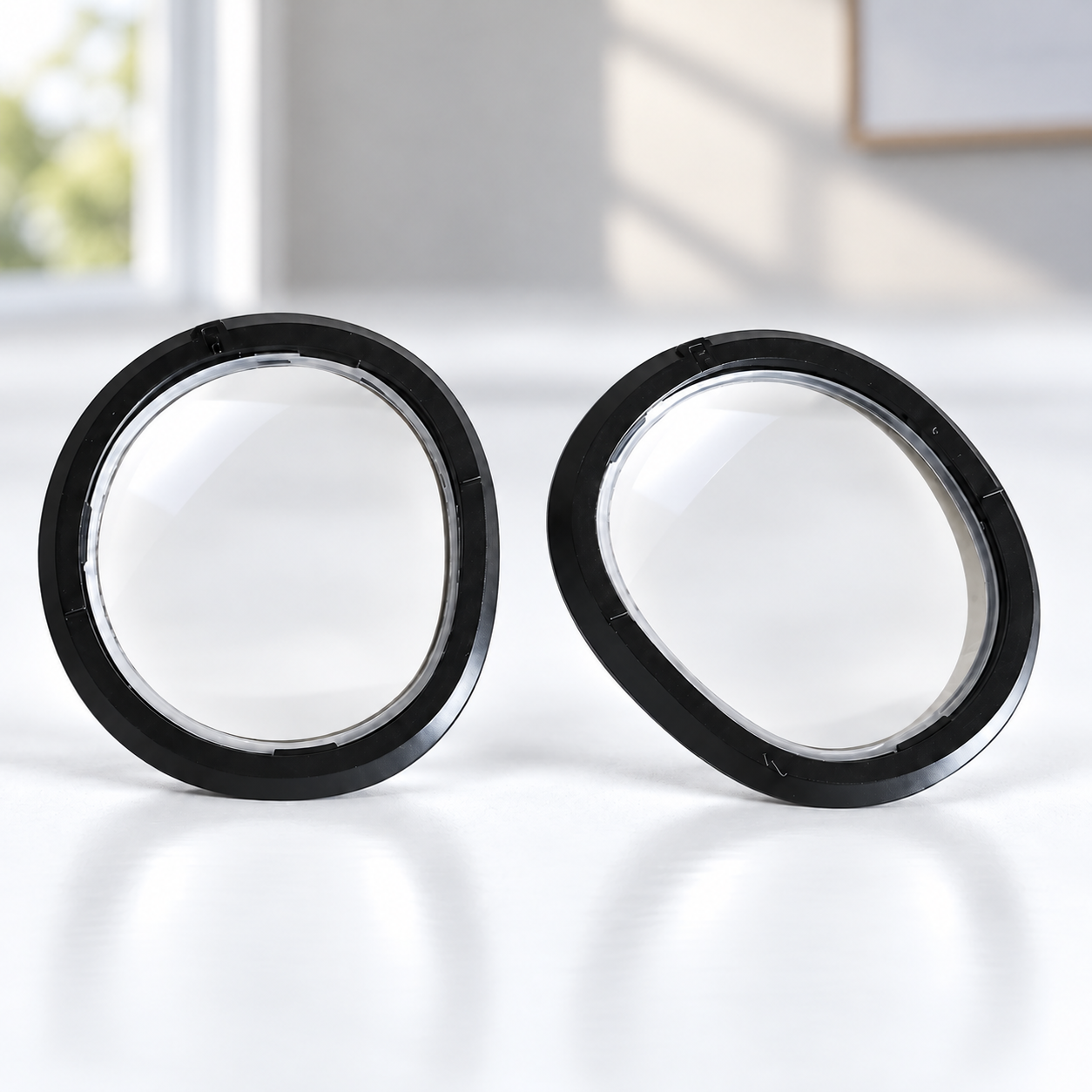
Ask about the finished insert, not only the lens index
“Will it be thin?” is hard to answer usefully without a specific product and prescription. Ask what the completed assembly will be like: the lens in its holder, mounted in your headset, with space for your face and eyelashes.
ZEISS’s discussion of spectacle-lens thickness explains how material, lens design and frame size affect the result. That is useful context for asking questions, but it does not calculate a VR insert’s dimensions. A high-index label alone cannot answer how far a particular mounted insert will extend toward your eyes.
Tell the supplier about the facial interface you actually use. Request available dimensions or an example with a comparable prescription, and ask what remains uncertain. A product image without measurements cannot establish clearance for your face. If the supplier has no comparable example, you can still ask how a fit problem would be reviewed before deciding whether to order.
Get an answer for your headset and both eyes
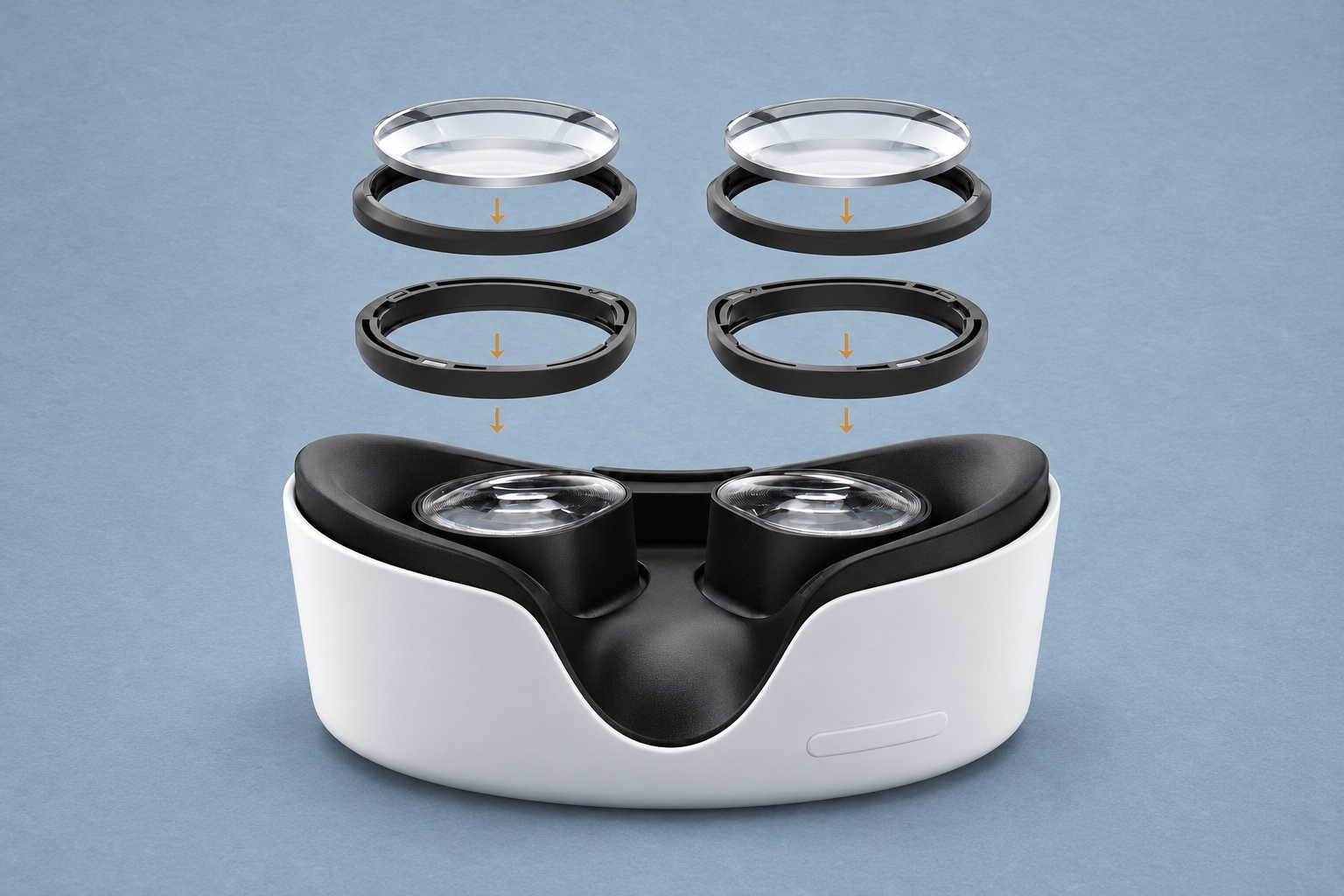
A recommendation from someone with a similar sphere is incomplete if their cylinder, frame or headset differs. Even within one headset family, use the exact model. Fovevia has separate Quest 3 and Quest 2 / Quest 3S listings.
Fovevia’s Prescription Guide explains the information required for the products it covers. A menu option does not confirm that every combination can be supplied. Check PD requirements for the selected product as well; another headset or supplier’s missing-PD answer is not a rule for this order.
Leave payment until these answers are clear
Before committing to a custom pair, you should be able to answer:
- Has the supplier accepted the full prescription for both eyes and this exact product?
- Is any extra review, lens sourcing or frame work required?
- What is the complete pair price after prescription-related charges and delivery costs?
- When does production start, and is its estimate separate from shipping transit?
- What happens if the finished pair differs from the accepted order, does not fit as described, or needs a correction?
For an initial Fovevia Support enquiry, give the device and the acceptance question. Ask which route to use if the team needs the prescription document; do not put the document or complete prescription values in the general Contact form or a public message. Keep the original record and the supplier’s acceptance together.
The decision is whether the supplier can confirm this complete order, with a clear price, timing and remedy—not whether a forum workaround gets the numbers through a form. More device-specific reading is available in Guides.